
Drop Your Shoulders, Change Your Mind

Last Friday night I watched the same few seconds of video six times while my tea went cold on the armrest. A twenty-nine-year-old from Tamil Nadu named Baranica Elangovan was sprinting down a runway in Nagoya holding a pole longer than my car, and a moment later she was upside down in the Japanese night, folding herself over a bar four metres and fifteen centimetres off the ground. Bronze. India had never won an Asian Games medal in pole vault before that evening, in the men's event or the women's.
I clapped alone in my living room like a man who had coached her personally. My contribution to her career stands at exactly zero. I clapped anyway.
Pole vault is a strange sport when you sit with it. A woman runs as fast as she can, jams a fibreglass pole into a box, lets it bend almost double, and then, at the highest and most frightening point of the whole jump, she has to let go of the one thing holding her up. Her body carries her to that moment. Only her mind can open the hand.
Baranica tore her ACL in 2020, the kind of knee injury that ends careers quietly, with nobody watching. She narrowly missed the squad for the last Asian Games in Hangzhou. Six years after the knee, she opened her hand at four metres fifteen and came down with a medal.
Then I went looking for the rest of India's week in Japan, and the highlights got harder to watch.
I play badminton at my forties , which means my knees hold a small press conference after every drop shot. So I watch the professionals the way a man with a scooter watches Formula One, with deep respect and very strong opinions. Satwiksairaj Rankireddy and Chirag Shetty, who won India's first-ever Asian Games badminton gold in Hangzhou, beat the reigning world champions from China in the team semi-final. A few days later, in the individual event, they were out in the first round. Their wrists were the same wrists. What changed was the weather inside their heads.

The shooting range told the same story in a quieter voice. In February, on home soil in Delhi, Indian shooters won fifteen golds at the Asian championships. In Nagoya, five full days passed before the first one arrived. Elavenil Valarivan led her air rifle final until three shots from the end and finished with silver. An Asian Games silver is a colossal thing, and I would happily trade my car for one. But anyone who has watched a final slip away in the last three shots knows those three shots were fired by the mind.
Here is what I keep coming back to. At this level, the bodies are almost identical. Similar nutrition plans, similar sports scientists, similar hours in similar gyms. The gap between the podium and the flight home lives in a few square centimetres behind the eyes.
I found myself wishing I could sit with some of these athletes for an hour or two. I would bring no new drills. I would bring the one switch Mind Flow is built around, the switch most people refuse to believe exists until they feel it click. Watch any highlights package with the sound off and you can pick the winner before the scoreboard does. One athlete keeps the shoulders low and the head level between points, playing the rally in front of her. The other has shoulders creeping toward the ears and eyes on the floor after an error, still replaying the last point.
The body tells on the mind. Every single time.
It tells on you and me too.
You have seen this at a railway station. Two people step off the same train at Egmore with the same bags. One walks out like she owns the platform. The other stops, checks the phone, looks up at the board, checks the phone again. If you were a pickpocket, and I am trusting you are one only for this paragraph, you already know which one you would follow.
In the early 1980s, two researchers named Betty Grayson and Morris Stein secretly filmed people walking down a street in New York and showed the tapes to prison inmates convicted of violent assault. The question was simple. Who would you go after? The prisoners agreed with each other to an unsettling degree, and they decided within seconds. Size mattered less than you would expect. So did age. What they were reading was the walk: strides too short or oddly long, feet that shuffled, arms and legs moving like separate committees instead of one body heading somewhere on purpose.
Those prisoners were reading minds, and they were doing it through knees and elbows. A lost, anxious mind leaks out through the gait.
Now the part that made me sit up. If the mind shapes the body, can you run the wire backwards?
A dermatologist named Eric Finzi noticed that his patients seemed happier after he injected Botox into the frown muscles between their eyebrows. Vanity, you would assume. So he teamed up with Norman Rosenthal, the psychiatrist who first described seasonal depression, and they ran a proper trial on people with major depression. Six weeks after a single round of injections, roughly half the treated patients had improved significantly.
On the placebo side, about one in seven had.
The treated patients could no longer frown. So the brain stopped receiving the message it had been reading off the face all day long: things are bad. The mind, starved of its evidence, began to doubt its own case. I am recommending Botox to precisely nobody. But there it is, the whole idea of this blog in one experiment. Change what the body is saying, and the mind has to rewrite its story.
I once read a piece by the late Sujatha, the Tamil writer who could explain a rocket and a romance in the same column, where he said that happiness changes shape with age. In his later years, he wrote, a good digestion and a clean morning in the bathroom gave him more joy than money or fame. Every man over forty-five reading this just nodded slowly.
It sounds like a joke. It is the most honest sentence about happiness I have ever read. Sujatha saw clearly what most of us learn only from a hospital bed: the body is the gate through which every pleasure and every pain has to enter. Keep the gate well oiled and the mind takes off from there.
So let me be practical, the way my grandmother was practical.
Start with water. Most of us drink water the way we reply to the school parents' WhatsApp group, only when there is an emergency. By the time you feel thirsty, you are already running dry, and losing even two per cent of your body's water is enough to blunt your attention and sour your mood. Keep a bottle where your eyes land every hour. Your afternoon bad mood is sometimes a glass of water that never happened.
Then food. Eat what your grandmother would recognise as food. Dal, greens, a fistful of protein at every meal, a fruit in place of the biscuit packet that mysteriously empties itself by four o'clock. Your gut and your brain talk to each other all day along the vagus nerve, and a gut living on fried snacks sends upstairs a very grumpy telegram. Fibre and fermented food keep that line clear. Our grandmothers were running a probiotic laboratory every night and calling it idli batter.
Then sleep, which is where the body sends the brain to the cleaners. Most adults need seven to nine hours. A dark room, a slow fan, the phone charging outside the bedroom. After one bad night, the emotional alarm centre of the brain turns jumpy the next day, which explains a great deal about certain Monday meetings.

Then movement. The human body was designed by a long line of ancestors who walked all day looking for lunch. A ten-minute walk after dinner flattens the sugar spike that meal would otherwise send into your blood. Lift heavy things a couple of times a week, even a bucket of water will do to begin. Step into the morning sun for ten minutes, and your body clock gets its daily instructions. Find a game you love. Mine is badminton, and my knees are still drafting their objections.
And then the vices, which I will handle gently, because I have negotiated with a gulab jamun at midnight and lost. Alcohol behaves like a polite burglar. It knocks you out at eleven and quietly steals your deep sleep by three. A cigarette calms you only by relieving the craving the last cigarette created. Sugar lifts you for twenty minutes and drops you for two hours. The late-night scroll feels like rest and works like a second shift. Each of these borrows happiness from tomorrow at a terrible interest rate.
Now the fun part. If the body can spoil the mind, it can also rescue it, and fast.
Check your shoulders right now, as you read this. I'll wait.
They were up near your ears, weren't they? Most of us carry our shoulders like a man carrying an invisible suitcase up a staircase. Drop them. Unclench your jaw. Let your tongue fall away from the roof of your mouth. Better still, open your mouth, let your tongue hang out slightly, and hold it for a few breaths. You look ridiculous. Your nervous system reads a slack jaw and a loose tongue as a signal that the tiger has left the building, and it begins to stand down.
Michael Jordan, the greatest basketball player of his era, played with his tongue hanging out. He picked the habit up from his father, who did the same while working on cars in the garage. The most feared man on the court looked, at his most dangerous moments, like a boy concentrating on a drawing. Loose face, lethal body.
Before the 100-metre final at the Beijing Olympics in 2008, with the whole world watching, Usain Bolt was clowning for the cameras, grinning, pointing, pretending to comb his hair. Then he ran a world record. That clowning was a pressure valve. A body that is playing finds it very hard to panic.
Rafael Nadal lines up his water bottles with their labels facing the court, touches his shoulders, his nose and his ears before every serve, in the same order, for twenty years. People laughed at the rituals. Nadal has described them as his way of putting order around himself so his mind could go quiet. When a stadium of fifteen thousand people is screaming, a man who knows exactly where his bottles are has one small corner of the world under control.
Then there is breathing, the most underused tool on the planet. Take two short breaths in through the nose, one on top of the other, and then one long, slow breath out through the mouth. Scientists at Stanford call it the physiological sigh. In a study of just over a hundred people, five minutes of this a day for a month lifted mood more than the same five minutes of mindfulness meditation. Our own yogis got there first with bhramari, the humming bee breath, where you close your ears and hum on the exhale until your skull buzzes. US Navy SEALs use box breathing: in for four counts, hold for four, out for four, hold for four. Men who jump out of aeroplanes at night trust this. You can trust it before a difficult phone call.
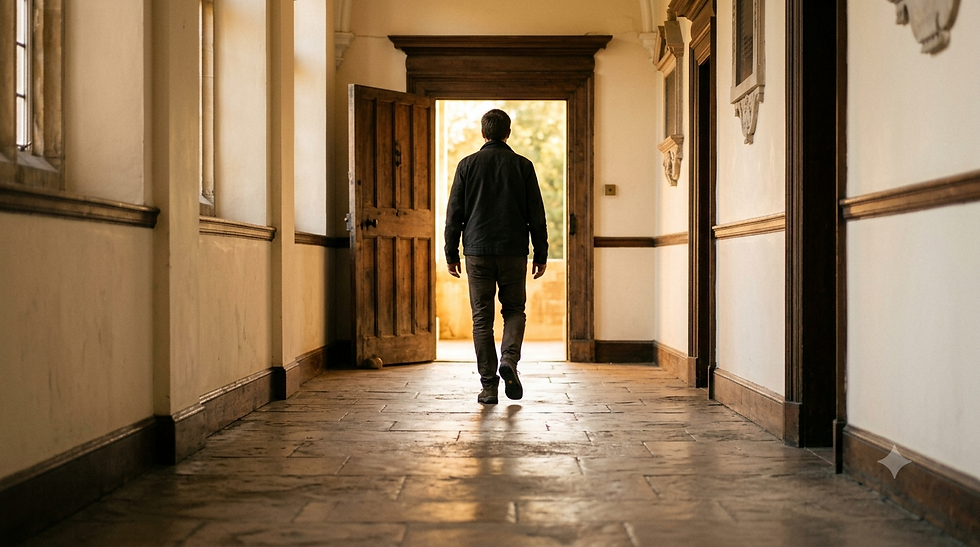
And finally, walk like the person those prisoners would never pick. Long, easy strides. Head level. Arms swinging as part of the same body. Do it for ten steps when you feel small, and notice how the mind hurries to catch up with the walk.
None of these hacks asks you to believe anything. That is their beauty. You simply move the body, and the mind receives the news.
Your body is the one thing that makes you human. It bleeds, it tires, it wants its idli and its eight hours, and one day it will stop. Your mind is what makes you Baranica, or Arunima, or whoever is holding this phone.
In April 2011, a young national-level volleyball player named Arunima Sinha was travelling on a train when robbers tried to snatch her chain. She fought back. They threw her off the moving train, and she lost her left leg below the knee. Two years later, in May 2013, she stood on the summit of Mount Everest, the first woman amputee to get there. Her body had been broken about as badly as a body can be broken short of dying. Her mind picked up the pieces and carried them to the highest point on earth.
Body and mind are two ends of the same pole. You plant one, you bend it, and at the top you let go with the other.
This week, in Nagoya, a woman from Tamil Nadu with a rebuilt knee ran at a bar four metres fifteen above the ground, and at the top of her flight she opened her hands. Tomorrow morning, before the first hard conversation of your day, drop your shoulders, let your jaw hang loose, breathe in twice and out once, slowly, and walk to that room with long strides. Your body will reach the door a second before your mind does.
Let it arrive with good news.


Comments