
The Flower That Needed No Witness
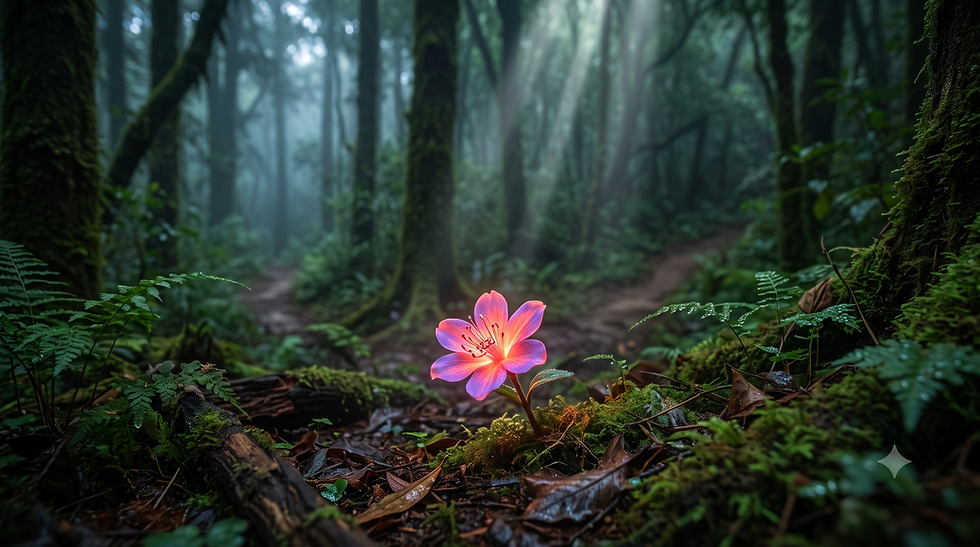
I was a boy the day I lost my people in the woods. This was long before mobile phones, so lost meant exactly that — no blue dot, no signal bar, no mother on speed dial. One minute the trekking group was a chatter of voices just ahead. The next, the trail had split in two, and I had taken the wrong half with complete confidence. That confidence, my wife will tell you, has survived into middle age.
I ran. Ferns slapped at my shins. My heart was doing its own trek somewhere up near my throat, and every tree had begun to look like every other tree.
And then, in the middle of all that green, I stopped.
A single wild flower stood beside the path, so radiant against the dense shade that it looked lit from the inside. I still have no word for its colour. I crouched and took one breath of it. It smelled divine, like the first minute after rain, sweeter than any garden I had known. My hand went toward the stem and stayed there, frozen. Plucking it felt like theft. So I left it, turned, and ran on until I heard my team shouting my name.
I found my people within the hour. That flower, I am certain, lived its brief little life on that slope and quietly vanished. In all likelihood, the only human who ever bent down to smell it was a panicking schoolboy with a search party to catch.
It never needed me. That is the part I keep coming back to.
In 2007, a young Chicago real estate agent named John Maloof walked into an auction house looking for old photographs for a neighbourhood history book. He paid about four hundred dollars for a box of negatives and rolls of film. None of it was any use for his book, so it sat in a corner.
When he finally held those negatives up to the light, he found street photography that could stand beside the greats of the twentieth century. A child mid-tantrum on a Chicago pavement. Shop windows holding the faint reflection of the woman who took the picture.
Over the years, roughly one hundred thousand of her negatives would end up with him. At that same auction, another buyer carried away more than a thousand rolls of her film that had never been developed at all.
Pictures she took and never once saw.
Her name, scribbled on a photo-lab envelope, was Vivian Maier. In 2009, Maloof typed it into a search engine. The first result was her obituary. She had died that April, at eighty-three.
Vivian Maier was a nanny. She moved to the Chicago area in 1956 and spent decades looking after other people’s children, walking them through the city with a camera hanging at her chest. She kept her work to herself. She entered no competitions and approached no gallery. Her belongings, including a lifetime of photographs, sat in rented storage lockers that eventually went under the hammer when the payments lapsed.
Within a few years of her death, her pictures were hanging in exhibitions across the world. In 2015, a documentary about her was nominated for an Oscar.
We tell her story as a happy ending. Genius discovered. Justice done, a little late.
I read it differently.
Vivian Maier was found because one particular box reached one particular curious man, and because he bothered to look. Change any single link in that chain and she is a nanny who liked taking pictures, and her negatives are landfill on the outskirts of Chicago.
So here is the uncomfortable question. How many Vivian Maiers went to the landfill?
I had the same feeling recently, reading about Hanuman Ansh, the film on Neem Karoli Baba. It was made for a reported two crore rupees, released in August 2026, and turned into the box-office surprise of the year. Its worldwide release was timed to 11 September, the day Maharaj-ji left his body in Vrindavan in 1973.
I first met him decades ago, through a documentary, on a grainy screen. The story the world loves goes like this. In 1967, a former Harvard psychologist named Richard Alpert travelled to India and sat at the feet of an old man wrapped in a plaid blanket. Alpert went home as Ram Dass, wrote Be Here Now, and carried the name of Neem Karoli Baba into millions of Western homes. In 1974, a nineteen-year-old named Steve Jobs travelled to the Himalayas to meet him and arrived months too late.
I was genuinely happy, reading about the film. A man I had admired on a small screen was finally on a big one.
And yet the boy who left the flower on that slope has a different suspicion. The real gems of this world will never be discovered, for the simplest reason. They have no need to be. They feel no itch to be seen, heard or praised. Maharaj-ji himself wrote no book and courted no press. He was found because others went out and told.
Somewhere in a village whose name you will never read, there is a woman who fed half her lane through a famine and told no one. She shone, and she went. No Harvard psychologist ever wandered past her door.
Demographers at the Population Reference Bureau estimate that roughly one hundred and seventeen billion humans have ever been born.
Sit with that number for a second. Then try this. Name all eight of your great-grandparents.
Go on. I’ll wait.
Most of us stall at two or three. Some of us stall at zero. These are people whose blood is running through your wrist at this very moment, and within three generations even their names have slipped through the floorboards.
The only real difference between the famous and the forgotten is a few extra decades. Vivian Maier has been granted a long encore. Neem Karoli Baba may be remembered for centuries. The flower on my slope got one breathless boy and a single afternoon. Run the clock forward far enough, and all three end up in the same place.
That is simply a fact of life. Every single thing about you will disappear. Your name, your house, the argument you won at the last family wedding, the LinkedIn post you rewrote four times — all of it.
Picture a man at 10:40 on a weeknight, refreshing a post he wrote that morning. Forty-one likes. His cousin’s post on the same topic has three hundred. He reads his own sentences again, looking for the flaw. His tea has gone cold beside the laptop.
There was a time when wanting to be seen kept us alive. For most of human history, a person forgotten by the tribe was a person left out in the cold, and the brain wired itself accordingly. That old hunger for applause once guarded our lives. Today, it mostly guards our phones.
And it charges a fee. Every time we shrink a dream to fit what other people might clap for, we pay it. Every time we hold back a strange idea because it might look foolish, we pay again. We become curators of a museum nobody is going to visit.
Now hold the flower beside that man and his cold tea.
It bloomed with everything it had, in a place no one would ever see. It made that scent for no audience. It burned its colour into the dark green as fully as if a thousand cameras were watching. And in all of that, it lost absolutely nothing by being unseen.

Once you accept that everything about you will disappear, the most curious freedom arrives. The fear of looking foolish loses its grip, because the people watching will disappear too.
The verdict you have been waiting for from the world will never arrive, and so you can stop waiting. You can sing badly at the next wedding. You can start the business at sixty-eight. You can write the book that sells four copies and love every page of it.
Impermanence is the most underrated superpower ever handed to a human being. It removes the audience, and leaves you alone with the life.
Somewhere in Chicago in the 1960s, a tall woman in a long coat and a sensible hat is standing on a pavement with the child in her care holding her hand. She lifts the camera at her chest, looks down into its viewfinder, and waits. A man passes. A pigeon lifts. She presses the shutter.
She may never develop that roll. She already has the only thing she wanted from it, which was the looking.
And on a forested slope I could never find again, a flower opened one morning with no one coming. It poured its whole colour into the shade and gave its scent away to the air. A lost boy happened to stumble past. The flower never knew he was there. He is still writing about it, all these years later.
So here is my one request. Before this ordinary Tuesday ends, do one thing fully that nobody will ever know about. Cook the evening meal with the care you would give a guest. Or write the page you will never post. Do it with everything you have, and then let it go, the way the flower let go of that afternoon.
You will disappear. So will I. Some of us will be remembered a little longer than others, and none of it will matter to the morning you are standing in right now.
Somewhere today there is a slope with no audience on it. It is exactly the right size for a life.
Go and bloom on it.


Comments