
Food for Thought — Literally
- Jul 6, 2025
- 18 min read

A Saturday, A Stomach, and A Sudden Spiritual Awakening
Every Saturday, I fast.
Not for religion. Not for science. Not even for abs.
I fast because…I love food too much.
Yes, that’s the truth. I fast once a week not to become a sage, but to save myself from becoming a savage.
See, Monday to Friday, I pretend to be a functional adult. But come Saturday, if I don’t consciously step in, I’ll end up in an emotional relationship with a plate of ghee roast and finish it off with a side of regret.
So, I fast. And that’s when the real drama begins.
My brainstem (which, in simple terms, is your body's ancestral monkey) starts screaming by 10:00 AM:
"Biriyani! Idiyappam! Bajji! Feed me, human!"
And my prefrontal cortex, the calm professor who believes in long-term goals and discipline, whispers back:
"Let’s rise above. We are not slaves to chutney."
Some days the professor wins. Other days the monkey kicks the professor off the chair and orders a chicken lollipop.
But Saturday fasting has taught me one thing — when your stomach is empty, your mind starts cooking thoughts.
I begin sniffing food like it’s luxury perfume. I walk by the kitchen like a jealous ex. I stare at my son's snack plate with a level of focus that NASA would envy.
But amidst all this... something strange happens.
By afternoon, the hunger becomes a sort of silence. A strange clarity arises. Thoughts slow down. It’s like my brain finally stops scrolling Instagram and starts checking in with life.
Sometimes, I even type things into Google like: “Does hunger improve brain function or just increase hallucinations of Vanjaram fry?”
I feel both — wiser and weirder.
And that’s when it hit me — food is not just what you eat. It’s what you become. Every bite we take is a message to the mind, a signal to the body, and a whisper to the soul.
So this blog is not about six-pack abs or salad goals. This is about the most underrated mind-training tool in your kitchen.
Yes, food.
Let’s explore it — not as a chef, but as a curious mind trainer.
Bon Appétit to your brain.
🧠 “You Are What You Eat” — More Than Just a Quote
Let’s get one thing straight: You are what you eat is not just a Pinterest-worthy wellness quote printed on your friend's reusable smoothie cup. It's ancient wisdom with a microbiome twist.
And in my case, if that quote is accurate, then I am…a weekend samosa filled with ambition, carbs, and deep spiritual guilt.

🏺 Origin Story: Before Kale Was Cool
The phrase “You are what you eat” dates back to the 1800s, but the idea is much older. Ayurveda, dating back thousands of years, spoke of “Ahara” (food) as one of the three pillars of life (along with sleep and celibacy — two out of three is not bad, right?).
Hippocrates, the father of modern medicine, once said:
“Let food be thy medicine and medicine be thy food.”
Which sounds beautiful, until you eat roadside egg kothu parotta at 11:45 PM and try convincing yourself you’re just following Hippocrates' advice with added masala.
🧬 Science Says: You’re Not Just Eating Food — You’re Building Yourself
Here's the unappetizing truth: That dosa you ate yesterday? It’s not gone. It’s currently negotiating rent inside your cells, hormones, and thoughts.
Let me break it down:
You eat food →
It breaks into nutrients (carbs, proteins, fats, vitamins) →
These nutrients become amino acids, glucose, fatty acids →
Which then become cells, hormones, and neurotransmitters →
Which affect your mood, memory, focus, sleep, and even decisions.
In short: You eat food. Food eats you back — biologically.
Even the serotonin that makes you feel happy and calm? Almost 90% is made in the gut. Not in the brain. Yes, your stomach is literally manufacturing your peace of mind while you scroll through Zomato.
🧠 Gut Feeling: Meet Your Second Brain
Your gut isn’t just a food pipe with good intentions. It has 100 million neurons, its own nervous system (the enteric nervous system), and trillions of bacteria that are basically your invisible roommates.
This entire ecosystem is called the gut microbiome, and it:
Talks to your brain via the vagus nerve
Produces neurotransmitters (like GABA, serotonin, dopamine)
Influences mood, immunity, and even behaviour
A 2019 study published in Nature Microbiology showed that imbalances in gut bacteria were linked to depression. Another study in Psychosomatic Medicine reported that probiotic-rich diets improved mood and reduced anxiety in participants.
So next time you’re irritable, don’t blame your spouse. Blame your lunch.
⏰ It’s Not Just What You Eat. It’s Also How Much, When, and Why
Imagine two people eating the same meal: One eats it with mindfulness and gratitude. The other devours it while doom-scrolling Twitter in a traffic jam.
Same food. Different digestion. Different hormonal responses.
Overeating, emotional eating, late-night bingeing — all these hijack your blood sugar, spike insulin, mess with sleep, and confuse your brain chemistry.
You are what you eat — yes. But also when you eat, why you eat, how much you eat, and how you feel when you eat.
Food isn’t just on your plate. It’s on your mind, your mood, your energy, and your identity.
"Tell me what you eat, and I will tell you what you are."— Jean Anthelme Brillat-Savarin, 1826
🧠 How Food Shapes the Way You Think
– Or Why Some Thoughts Are Salad Thoughts and Others Are Biriyani Brainwaves

Let me confess something dangerous.
I’ve had pani puri and attempted to write an important email immediately after. What came out wasn’t an email. It was chaos. With bullet points. And hiccups.
Another day, I had dal, greens, and some grounded humility — and boom! I was quoting Rumi while finishing a report.
That’s when I realised: Food doesn’t just go to your stomach. It goes to your mind first.
🎯 1. Neurotransmitters: The Mood Managers Inside Your Plate
Your thoughts don’t float in thin air. They’re the product of neurotransmitters — chemical messengers that determine how you feel, think, decide, and even fall in love with chocolate.
And guess what? These chemicals are built using nutrients from your food.
Let’s break it down :
Serotonin = the “calm and content” chemical
→ made from tryptophan (found in oats, dairy, banana, nuts)
→ 90% made in the gut, not brain
→ Which means: your gut = your mood factory
Dopamine = the “focus and motivation” chemical
→ made from tyrosine (in cheese, eggs, legumes)
→ Makes you chase goals… or YouTube shorts, depending on diet
GABA = the “relax and sleep well” chemical
→ made from glutamate (found in spinach, broccoli, sweet potatoes)
→ Basically, your brain’s brakes system
No nutrients = no raw material = no calm/focus/joy = existential confusion.
🧁 2. Sugar and Processed Foods: The Real Brain Fog Machine
Ever had a packet of chips and suddenly forgot what day it is?
Processed food is like a bad relationship: Exciting at first. Regrettable later. And somehow, you keep going back.
Why it messes with the mind:
Massive glucose spike → insulin surge → energy crash
Triggers inflammation in the brain
Alters gut bacteria → leads to anxiety, mood swings, and poor memory
A 2015 study in The American Journal of Clinical Nutrition linked high sugar intake to depressive symptoms and cognitive decline.
In other words: Too many cream biscuits → too few creative ideas
🧠 3. The Brain Food Avengers: Omega-3s, Magnesium, and Complex Carbs
Want clearer thinking? Better mood? Less overthinking about why your crush didn’t reply?
Your brain is 60% fat, and it needs specific nutrients to function like a boss.
Omega-3 fatty acids (found in walnuts, flaxseeds, fatty fish)
→ Improve memory, focus, emotional resilience
Magnesium (in dark leafy greens, pumpkin seeds)
→ Calms the nervous system, reduces anxiety
→ Deficiency = brain that acts like a frustrated intern
Complex carbs (quinoa, brown rice, millets)
→ Provide steady glucose = brain’s main fuel
→ No crash, no drama
These aren’t just nutrients — they’re neural support staff.
😋 4. Real-Life Case Studies: Pani Puri vs Dal + Greens
Let’s keep it simple.
Pani Puri Brain:
Fireworks of salt, spice, and sugar
Brain races like a toddler on a trampoline
Emotions go on overdrive — joy, guilt, gas, regret
Thinking becomes reactive.
("I should call my ex." – NO, you shouldn’t. That’s the chutney talking.)
Dal + Greens Brain:
Slow, clean energy
Serotonin factory in full swing
Clearer decisions: “Let’s take a walk. Let’s finish that task.”
Thoughts are not spicy, but sensible.
Eat smart, not for abs — but for awareness. Because the first ingredient of a good thought… is always food.
💤 Why Food Sometimes Makes You Sleepy Instead of Active
– Or Why Your Lunch Is Plotting Against Your Productivity
Let me tell you what happens every weekday at 2:05 PM.
I’m at my desk, pretending to work, with a laptop open and eyes half-closed. My brain has gone on airplane mode. My body? Stuck in DigestOS version 12.0.
And it all began with that innocent-looking plate of rice, sambar, and extra potato fry.
I eat lunch. My body decides it’s bedtime. My boss thinks I’m lazy. But scientifically…I’m just advanced.

🧘♂️ 1. Parasympathetic Activation — “Rest & Digest” Mode
After a meal, your nervous system makes a switch.
From:🚨 Sympathetic mode → “Fight or Flight” (Productivity! Emails! Survival!)
To:🧘 Parasympathetic mode → “Rest and Digest” (Burp! Nap! Nirvana!)
This is your body's way of saying:
"Thank you for the biriyani. Now kindly sit down, shut up, and let me process this masterpiece."
The blood rushes to your gut to help digestion, which means less blood (and oxygen) to the brain. End result? You become spiritually one with the chair.
🍛 2. Heavy Meals = Energy Hog
Digestion is not some passive internal fan running in the background. It’s a full-blown biochemical orchestra that demands energy, enzymes, hormones, and brain silence.
Especially when you eat:
Too much rice or pasta
Fried food
Creamy, cheesy meals
Sugary desserts
Your body spends so much energy breaking it down, it borrows it from your brain. So, you’re technically not sleepy —you’re being outvoted by your own internal digestive staff.
🧬 3. Insulin Spike → Tryptophan → Serotonin → Melatonin → Yawn
Let’s get geeky for a second:
You eat a carb-heavy meal → blood sugar rises
Body releases insulin to process the sugar
Insulin also lets in tryptophan, an amino acid
Tryptophan converts into serotonin (happy hormone)
Serotonin becomes melatonin (sleep hormone)
And suddenly, you’re drafting reports in your dreams.
So yes, scientifically speaking: That second helping of curd rice? It was practically a sedative.
🪑 4. Lunch Meetings vs Post-Lunch Meetings: The Real Productivity War
Let’s be honest: Pre-lunch meetings have decisions. Post-lunch meetings have digestion.
You’ll notice the shift:
Before lunch: “Let’s explore 3 new strategies.”
After lunch: “Can we postpone this? I need to explore my inner self.”
If you want ideas, schedule before food. If you want silence and subtle snoring, try 2 PM onwards.
✅ 5. Practical Tips to Avoid Post-Meal Sleep
What to Avoid:
Refined carbs (white rice, noodles, white bread) in large portions
Sugary drinks or desserts
Large portions of red meat at lunch
What to Prefer:
Balanced meal: Protein + fibre + complex carbs
Add greens, nuts, and a bit of lemon (boosts digestion)
Hydrate before, not immediately after meals
Eat mindfully and chew well (yes, chewing = better energy)
Also…Walk for 5 minutes after eating. Yes. That simple step can keep your brain from hibernating.
Don’t blame your food. Blame how much and what you eat.
Because food is supposed to fuel your fire — not extinguish your ambition.
Eat light. Think bright.
🥦 Veg vs Non-Veg — Mind Edition
(Not a Moral Debate, Just a Mental One)
Let’s get one thing clear right at the start:
This is not an emotional breakdown of food. This is not a moral analysis. This is a mental audit.
Because people often say, “Eating meat makes you aggressive. ”And I say —
“If that’s true, I should’ve been in WWE by now, pile-driving people every Sunday.”

😡 1. Does Meat Consumption Affect Aggression or Negative Thoughts?
Let’s address the spicy rumour first. No, there’s no scientific proof that eating non-veg makes you more violent.
Yes, animal protein increases dopamine and norepinephrine production, which may lead to higher energy and alertness, but there’s zero evidence that it turns you into a rowdy at a traffic signal.
A 2010 meta-analysis from Nutrition Journal confirmed that no direct link exists between meat-eating and aggressive behaviour. If someone becomes hostile after mutton biriyani, it’s not the meat. It’s probably because someone else took the last leg piece.
🧬 2. Amino Acids & Brain Function: Complete vs Incomplete Proteins
Now this part matters.
Your brain needs amino acids (building blocks of protein) to produce neurotransmitters like:
Tryptophan → Serotonin
Tyrosine → Dopamine
Glutamate → GABA
Animal protein (chicken, fish, eggs) = complete protein→ Contains all 9 essential amino acids→ Quick, efficient neurotransmitter production
Plant protein (dal, tofu, legumes) = incomplete→ Might lack one or two amino acids→ But combinations (like rice + dal) balance it out
In short: Both work — just different operating systems. One’s plug-and-play, the other’s DIY. Choose your tech.
📊 3. Studies on Vegetarians and Mood/Cognition
Here’s where it gets interesting.
Some studies show vegetarians have better mood stability due to:
Higher intake of antioxidants
Less arachidonic acid (found in meat, linked to inflammation)
More fibre → healthier gut → better serotonin
But other studies also report that low intake of B12, iron, and omega-3s in strict vegetarians can lead to:
Fatigue
Anxiety
Brain fog
So the results are mixed. It’s not veg vs non-veg. It’s about nutrient balance.
Whether you're team spinach or team chicken, if you're not getting your B12, your brain will stage a protest either way.
🧘♂️ 4. Cultural & Emotional Overlays on Food and Guilt
Let’s be honest — sometimes the food isn’t the problem. It’s the story attached to it.
You were told eating non-veg is "tamasic" or "sinful"? That guilt can create emotional dissonance → stress → cortisol spike → negative mood.
You were raised with love around meat dishes? Then the same food may bring comfort and emotional calm.
In the mind, a paneer roll eaten with guilt can do more damage than a mutton soup sipped with peace.
🧠 5. Bio-Individuality — One Stomach Doesn’t Fit All Minds
Some people eat eggs and feel like Einstein. Others eat the same and feel like a sleepy sloth.
Your genes, your gut bacteria, your habits, your upbringing — all of it decides how food affects you.
There’s no universal right diet for the mind. Only the one that fuels your clarity, your focus, your peace.
So don’t ask:
“Is veg better than non-veg? ”Ask: “What food gives me the mind I want to live with?”
😂 My Realisation:
“I’ve had days when I ate chicken curry and felt calm. I’ve also had days when I ate beetroot salad and plotted revenge. Moral: It’s not the meat. It’s the mood I bring to the menu.”
Eat consciously. Eat kindly. Because at the end of the day, your mind doesn't care what your food looks like —it only cares how it makes you feel.
⚛️ When All Food Breaks Down into Atoms, Why Does It Still Matter?
– Or Why You Can’t Just Eat Vada Pav and Call It Quantum Nutrition
Here’s a thought I had once while fasting on a Saturday and watching a gulab jamun swirl in sugar syrup like a planet in a galaxy:
“If everything breaks down into atoms… then isn’t gulab jamun the same as a banana?”
Existential? Yes. Scientific? Almost. Helpful for dietary planning? Absolutely not.
Because yes, all food eventually breaks down into atoms —but no, that doesn’t mean a pakoda and a papaya are spiritually identical.
If they were, then the entire science of nutrition could be replaced with the phrase:
“Eat anything. We’re all stardust anyway.”

🧪 1. Biochemistry vs Atom-Level Theory
Let’s get nerdy for a minute.
Atoms are the building blocks of matter — yes. But when we talk about food and digestion, we’re dealing with biochemistry, not just physics.
The body doesn’t care about atoms. It cares about structures: carbs, proteins, fats, vitamins, enzymes — all made of molecules arranged in precise patterns.
Saying “All food becomes atoms anyway” is like saying “All books are just ink on paper. ”True. But would you say the Bhagavad Gita is the same as a phone bill?
🧬 2. Meet the Middlemen: Enzymes, Hormones & the Microbiome
When you eat, your body doesn’t throw a party for atoms. It activates an elite force of digestive enzymes, hormones, and gut bacteria that:
Break food into usable components
Absorb them at the right place, right time
Convert them into hormones, neurotransmitters, and energy
Communicate constantly with your brain
Your microbiome literally reacts differently to different types of food. One study from Cell (2019) showed that people’s blood sugar response to the same meal varied dramatically — meaning, your papaya is not my papaya.
So yeah, the source, context, and gut chemistry matter — not just the final atomic rubble.
🧩 3. Structure, Synergy & Source — It’s Not Just the Ingredient, It’s the Arrangement
Let’s do a comparison.
A** Vitamin C capsule**vs. An amla fruit (Indian gooseberry)
Both may contain ascorbic acid, but the amla comes with:
Antioxidants
Polyphenols
Fibre
Subtle desi wisdom
These support the absorption, make digestion smoother, and give your body more value than isolated atoms.
Same applies to carbs. White sugar and an apple both give glucose, but one gives it like a friend offering tea. The other throws it at you like a cricket ball aimed at your face.
⚠️ 4. The Fallacy of “Everything is Energy, So Eat Anything”
You’ve heard people say:
“Everything is energy, bro. Eat with love, and it’ll be fine.”
Sure, but if that love is aimed at a double cheeseburger at midnight, your pancreas won’t appreciate the spiritual vibe.
Energy is not the problem. It’s how it’s structured, released, and processed that makes the difference.
Would you charge your phone with lightning just because it’s ‘energy’? Exactly.
😂 5. My Realisation:
“Sure, a pakoda and a papaya both become atoms. But only one makes you fart artistically, and the other makes your skin glow.”
Yes, atoms are the end point. But don’t live at the end point of reality. Live at the experience of it.
Your brain doesn’t think in atoms. It thinks in focus, fog, joy, dullness, drive. And those are shaped by the quality, source, and structure of what you eat.
Atoms may be equal. But experiences are not.
🥬 What to Eat and What Not to Eat?
– And Why Your Grandmother Was the Real Nutritionist
Let me say something controversial: My grandmother was ahead of Harvard in nutrition.
She didn’t count macros. She didn’t care about gluten. She never said the word “superfood.”
But she knew exactly what to eat, when to eat, how much to eat, and who to scold for eating too much.
Her food was simple, seasonal, fresh, and made with one secret ingredient modern kitchens don’t always have:👉🏽 Accountability.
As she used to say:
“Don’t eat from people you wouldn’t marry. Or at least sit next to on a train.”

🌾 1. Clean Eating, Seasonal Wisdom & Grandmother’s Radar
Seasonal eating wasn’t a health trend. It was common sense. Mangoes in summer, millets in monsoon, turmeric when someone sneezed.
These weren’t random. They were rooted in body rhythm, crop cycle, and climate balance.
Clean eating didn’t mean filtered Instagram photos. It meant:
No reheating thrice
No "open fridge → eat random leftovers" strategy
No packaged shortcuts that say “Ready to eat” but feel “Ready to regret”
The principle was simple:
Eat what the earth grows now. Not what the internet shouts forever.
☣️ 2. Pesticides, Preservatives & Mind Health
Let’s get serious for a second.
Modern food isn’t just food. It’s chemistry.
Pesticides: Linked to brain fog, hormone disruption, and neurological issues (especially in kids)
Preservatives like sodium benzoate and artificial colors: May worsen hyperactivity and anxiety in some people
Additives: Can disrupt the gut microbiome → affects serotonin, dopamine → affects your mood and focus
In short: Your cookie might be cute, but it could also be a mood-altering edible chemical lab.
🛒 3. Organic vs Locally Sourced vs Industrial
Organic: Grown without synthetic pesticides, fertilizers, or GMOs→ Cleaner, safer, but more expensive (and not always accessible or authentic)
Locally Sourced: Grown nearby, fresher, more nutrient-rich due to shorter storage→ Often better than “organic” flown 3,000 km in plastic wrap
Industrial Produce: Mass-produced, uniform-looking, shelf-stable→ Longer shelf life, shorter real-life energy
So what to choose?
Ask three questions:
Where did this come from?
Who grew it or made it?
How long did it wait before reaching me?
Because food carries not just calories — but intent, environment, and energy.
🍲 4. Food as Medicine vs Food as Filler
We now live in the era of filler food — eaten to pass time, numb stress, or fill emotional gaps.
But your brain doesn’t want filler. It wants fuel.
Here’s a simple rule of thumb:
If your food heals you, it’s medicine. If your food needs healing, it’s filler.
Turmeric in rasam = medicine. Green color in mint chutney that glows in the dark = filler.(And possibly alien technology.)
🏷 5. Reading Labels Without Losing Your Mind
Label reading can be either:
An empowering experience
Or an anxiety attack in font size 6
Here’s how to simplify it:
If the ingredient list is longer than your last WhatsApp fight, keep it back.
If you can’t pronounce half the words, neither can your liver.
If sugar appears in 3 forms (glucose, sucrose, maltodextrin) — it’s a dessert in disguise.
Always check added sugar, sodium, trans fats, preservatives.
Don’t get tricked by labels like “lite”, “fit”, “zero guilt” — they often just mean zero truth.
😂 My Realisation :
“My grandmother didn’t check calories. She just checked the smell, the color, and who made it. And if she didn’t like the answer, even ghee wouldn’t save it.”
Eat food that’s closer to the soil, the sun, and someone’s care. Not just what’s closer to offers, ads, and aisles.
Your body isn’t just digesting food. It’s absorbing the life force, the story, the honesty behind what you eat.
Next time you eat, don’t ask:
“Is this organic? ”Ask: “Is this real?”
⏳ Fasting & Intermittent Fasting — What Happens to the Mind?
– Or Why an Empty Stomach Often Has the Fullest Realisations
There’s a special kind of silence that comes when you skip lunch. It’s not spiritual at first. It’s your stomach negotiating loudly with your dignity.
You don’t become calm. You become very alert — mostly to food smells, fridge sounds, and the neighbour unwrapping chips.
But somewhere in between the third cup of hot water and the 17th glass of air you sip...Something shifts.
You start thinking clearly. You notice your breathing. You remember the passwords you forgot. You question life, relationships, and that one murukku you left uneaten last night.
Because truly —
“Nothing makes you more philosophical than a grumbling stomach and a ticking clock.”

🦴 1. Evolutionary Roots of Fasting & Alertness
Our ancestors didn’t have three meals a day. They had one meal. Sometimes per day, sometimes per week — depending on how lucky (or slow) the deer was.
So our bodies evolved to become sharper when hungry, not sluggish.
Hunger = heightened senses
Empty stomach = increased adrenaline
Fasting = evolutionary switch to “let’s hunt or die trying”
This is why you often feel more focused on an empty stomach than after a plate of pongal.
🧠 2. Ketones and Clarity — The Brain’s Backup Fuel
When you fast, your body uses up its glucose stores. Then something magical happens: It starts producing ketones — a clean, efficient fuel from fat.
Ketones:
Cross the blood-brain barrier easily
Provide stable, sustained energy
Reduce oxidative stress in the brain
Promote mental clarity and sharpness
This is the zone where
You start writing blogs, solving deep problems, and planning your entire future —until someone walks by with samosas, and it all comes crashing down.
🔄 3. Hormonal Reset: Cortisol, Insulin & BDNF
Fasting isn’t just skipping food — it’s recalibrating your internal chemistry.
Here’s what gets tweaked:
Insulin drops → fat burns → energy improves
Cortisol balances → reduced stress reactivity
BDNF (Brain-Derived Neurotrophic Factor) rises → improves learning, memory, neuroplasticity
Growth hormone spikes → slows aging, repairs cells
Translation: You become a sharper, calmer, slightly more smug version of yourself.
🧘 4. Mental Benefits: Focus, Control & Calm
Why do monks fast? Why do ancient traditions promote it?
Because when your body isn’t busy digesting, your mind gets time to digest life.
Benefits observed in modern research:
Enhanced concentration
Increased self-awareness
Reduced brain fog
Boost in emotional regulation
Easier habit formation (you feel more in charge)
It’s not just discipline. It’s mental decluttering. Your mind cleans the windows and suddenly — you can see clearly.
📱 5. Modern Fasting: Between Ancient Wisdom & Trending Hashtags
Today’s fasting has apps, timers, and communities.
Some do 16:8, some do 24-hour, some do it for gut healing, some to fit into jeans.
But fasting is not just about when you eat. It’s about how you think during the pause.
If your fast is spent scrolling food reels and waiting for the clock to hit 2:00 PM —That’s hunger with Wi-Fi. Not fasting.
My Realisation:
“When you fast, time slows down, smells sharpen, and memories return. You become a spiritual detective who can hear dosa being fried in the next apartment.”
It’s not a diet. It’s mind training through temporary madness.
Fasting isn't about starving. It’s about stopping, resetting, and remembering that hunger is not always your enemy. Sometimes, it’s your best teacher.
Your stomach might be empty, but your mind becomes full —of clarity, strength, and a strange, peaceful power.
🌈 Conclusion — The Mind is What the Stomach Whispered
Some say the heart leads the way. Some say it’s the mind.
But after writing this blog series…I’ve realised something else.
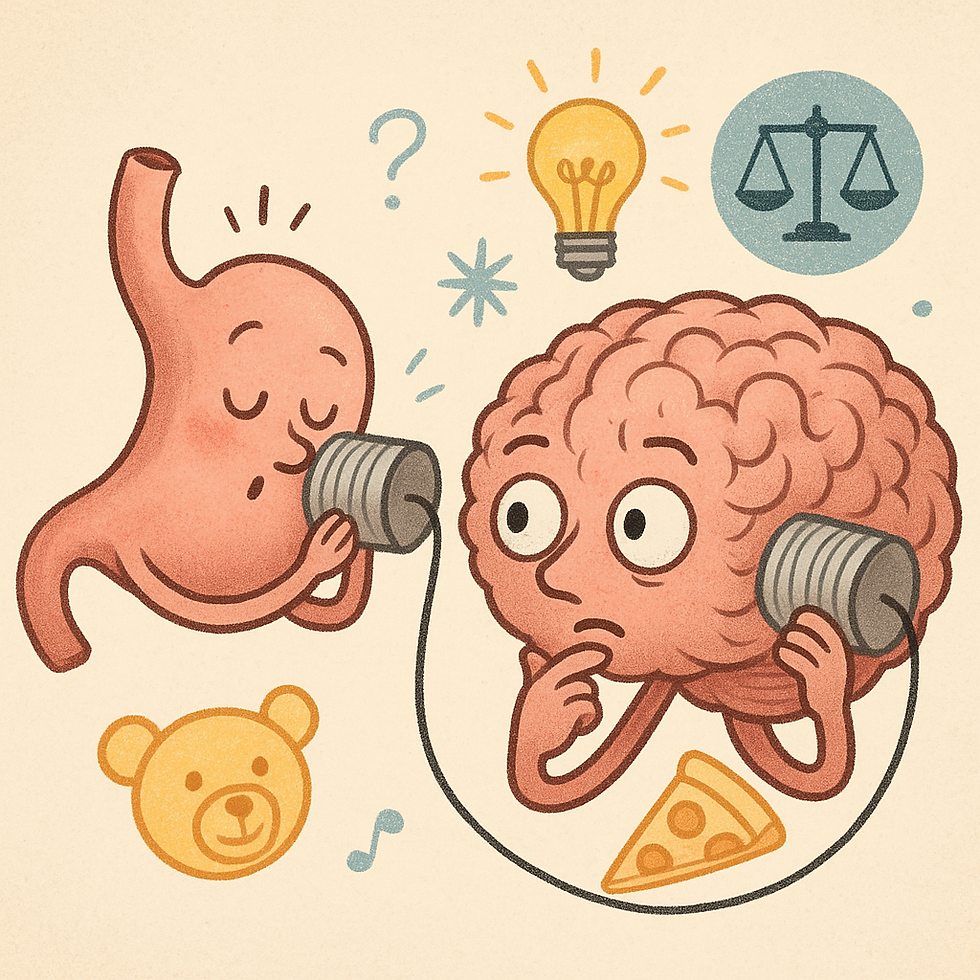
Sometimes, it’s the stomach. Whispering softly. Grumbling loudly. Guiding your thoughts, your moods, and even your decisions.
Yes — your lunch might just be your life coach.
🧠 Recap in a Poetic Bite:
You are what you eat — not just physically, but mentally, emotionally, and philosophically.
Your food shapes thoughts through neurotransmitters. It sharpens or fogs your focus.
Sometimes, it gives you sleep instead of strength — and your post-lunch yawns aren't laziness, they’re biology.
Whether you eat veg or non-veg, it’s not about morals — it’s about how your mind responds.
Even if everything becomes atoms, not all food feels the same — because structure, source, and synergy matter.
Grandmother wisdom beats food trends. Real food is grown, not branded.
Fasting clears not just your plate — it clears your patterns, your pace, and sometimes even your purpose.
🔁 The Loop: Emotions, Chemistry, Habits
Every bite starts a loop:
Food → Hormones → Mood → Decisions → Cravings → Food again
If your diet is full of confusion, your mind will reflect that. If your plate is peaceful, your thoughts often follow.
The goal isn’t perfection. The goal is awareness.
🌱 Eat for the Future You
Before your next meal, just ask one simple question:
“Will this food serve my energy, my clarity, and my peace — not just my taste buds?”
Sometimes the answer will be yes. Sometimes, the jalebi wins. And that’s okay.
Because it’s not about strict control. It’s about conscious connection.
Sign-Off:
Eat with awareness. Digest with gratitude. Think like a monk. But once in a while…Eat like your childhood.
(Especially if it's a rainy day and someone brings hot bajjis.)
🧘♂️ Final Thought:
Your body is made of food. Your mind is made of what food becomes. So don’t just feed yourself. Feel yourself evolve.
Because your plate isn’t just your fuel —It’s your first philosophy.
🥄 Next Week on the Menu: “The Power of One Push-Up”
We chase grand transformations — 6-pack abs, millionaire mornings, Zen-like focus. But what if your life doesn’t need a revolution? Just one tiny, ridiculously doable habit. Like a nano workout. Or a nano ritual.
Yes, I'm talking about brushing your teeth with one leg raised, or doing one squat while waiting for your tea to boil.
Sounds silly? Maybe. But that silly act might just rewire your identity, build your discipline, and save you from a future full of regrets (and knee pain).
Because the biggest change often starts with something so small, your brain doesn’t have the energy to resist it.
👉🏽 Next week: The Science, The Psychology, and The Stories behind Nano Habits.
One small step for your schedule. One giant leap for your sanity.


Comments