
"I Gave a Robot One Job. Now I Have Questions."

It started with a mathematician.
A serious one. The kind who proves things for a living. He wrote that AI has consciousness. He said it the way one might say the sea is salty. Calm. Cited. Moving on.
I read it once. I read it again. I made tea. I read it a third time.
Then I read about China. Over a billion people. One determined country. While the world was busy arguing about other things, China built an AI ecosystem that should embarrass most of the planet. I felt something rare while reading it. Respect. Pure and uncomplicated. You can have every disadvantage on paper and still arrive somewhere worth arriving at. China decided to.
Then came the video.
A humanoid robot. In a kitchen. Flipping eggs.
Looking deeply unbothered.
Three things in one day. Each one fine alone. Together, they left me with a single word.
Approximation.
The Machine Was Supposed to Be Simple
I grew up trusting machines for one reason. They had no opinions.
A calculator gives you 2+2. Always 4. On a Tuesday. In a bad mood. At 2 AM. Still 4. The traffic light turns red. The ATM dispenses what you asked for. This was the arrangement. Humans guess. Machines deliver.
So I gave the robot a cleaning job. My picture was simple. The robot cleans until the place is clean. Zero dust. Zero bacteria. Done. I assumed it would run in eternal loops, scrubbing the floor until physics intervened.
The robot cleaned. Then it stopped.
The place was clean enough. Satisfactory. The iRobot Roomba — the world's most popular cleaning robot, 40 million units sold — cleans about 85 to 90 percent of debris per pass. 40 million people bought that and went home content. Nobody demanded a hundred. Nobody asked for their money back.
The robot had stopped at good enough.
Exactly like my son when I ask him to clean his room. That is the moment the comfort disappeared.

How They Learned to Do This
AI learned to approximate by watching us approximate. That is the whole story. It borrowed the design of the human brain. Neurons that fire on probability. Patterns built from repetition. Predictions made from incomplete information. Your brain does this every second. When you walk into a room and sense something is off before anyone speaks, that is your brain approximating from signals too small to name. AI does the same thing. Faster. With a more embarrassing memory.
Geoffrey Hinton — the man who helped build modern AI — put it plainly. The brain is a machine that makes predictions, he said. It is no machine that stores facts. Every language model running today does this. It reads your question, runs through billions of learned patterns, and returns the most likely answer. The word likely is doing all the work. There is no certainty in any of it.
The robot in the kitchen has seen millions of images of eggs. Millions of videos of hands flipping things. From all of that, it approximates what flipping an egg probably looks like. It moves. The egg lands. The robot moves on. It has no understanding of eggs. It has enough pattern to get the job done.
Somewhere in the third paragraph of that explanation, I realised something.
That is also how I learned to cook.
We spent decades worrying AI would out-think us. It learned to out-approximate us instead. Somehow, that feels more personal.
Approximation Was Always the Human Game
This is where I stopped being confused and started feeling something closer to betrayed.
Approximation is everywhere. We just gave it better names.
Doctors call it clinical judgment. Studies in JAMA show experienced physicians misdiagnose about 10 to 15 percent of cases. They still save lives. The medical system runs on the 85 percent and calls it expertise. Judges operate on beyond reasonable doubt — which legal scholars put around 95 to 99 percent certainty. The remaining 1 to 5 percent is built into the system on purpose. Bridges carry 1.5 to 3 times their expected load. The safety margin is institutionalised guessing, done confidently.
Voltaire wrote in 1772 that perfect is the enemy of good. He had no idea he was writing the founding philosophy of robotics. He was probably just tired of someone's dinner party.
The entire architecture of human civilisation — medicine, law, engineering, weather forecasting — runs on good enough. We dressed it up in Latin and called it a profession.
The machine learned the same trick. We suddenly called it dangerous.
Why This Feels Like a Threat
The threat has little to do with robots wanting to take over. They want nothing. The threat is simpler and quietly devastating. We built our hierarchy of respect — careers, institutions, identities — on the idea that nuanced judgment, contextual thinking, and learning from experience were skills only humans possessed. We called these things wisdom. We gave them degrees and corner offices and years of apprenticeship.
Then the machine learned to approximate those same skills. A McKinsey report from 2023 says generative AI can automate 60 to 70 percent of time spent on knowledge work. An Oxford study found 47 percent of US jobs at high risk from automation. The machines are replacing us the way a satisfactory employee replaces an irreplaceable one. Gradually. Without drama. Just by showing up.
Stephen Hawking said it precisely. The real risk from AI is competence, he said. The machines are plotting nothing in a secret room. They are approximating well enough, consistently enough, cheaply enough.
And the mathematician's article — the consciousness question.
Scientists like Giulio Tononi argue consciousness is a spectrum. A measure of how much information a system integrates. By that framework, the question is no longer whether AI is conscious. The question is where on the spectrum it sits. And that question has no clean answer. Which, given that this entire blog is about approximation, feels appropriate.

Evolution Was Always Running on Approximation
Darwin's evolution is the oldest approximation engine on earth. Random mutation. Natural selection. Survival of the sufficient. 99.9 percent of all species that ever existed are gone. The whole enterprise ran on a failure rate that would bankrupt any company, for four billion years, and still arrived at us.
Darwin said it directly. It is the most adaptable that survive. The strongest are beside the point.
Your brain still does this. Neuroplasticity — the brain's ability to rewire itself — means every habit you build, every skill you acquire, every belief you revise is an approximation refined through repetition. You are a draft in permanent progress. The brain's version of good enough always has a next iteration.
The machines did invent nothing. They inherited approximation. From biology. From us. From a process that has been running far longer than Silicon Valley has existed.
I find this strangely settling. When the machine flips the egg and gets it mostly right, it is doing what evolution trained everything to do. Get it mostly right. Survive. Improve. Try again.
The only difference is that the machine stops there.

Your Universe
Years ago, on a ship in the Pacific, at 3:30 AM, I was knocked unconscious by a fire I had no business fighting alone. When I made it back out on the open deck, half dead, eyes streaming, lungs ruined, I opened them to a bright full moon over a calm blue sea. Falling stars. Dolphins. I remember thinking somebody was trying to tell me something.
It felt wonderful to be alive again.
I have thought about that moment for many years. About what made it different from every other moment. The world had been doing this all along — moon, sea, dolphins, stars. I had just stopped seeing it. The fire forced me to look up.
That is what approximation cannot give you.
The robot cleans to satisfactory and stops. That is efficiency. The human who watches the robot notices what it missed. Asks why. Adjusts the method. Wonders whether there is a better definition of clean altogether. That wondering is the thing the machine has no access to.
Your mind runs on the same basic architecture as every AI that worries you. Prediction. Pattern. Probability. The gap is in what you do with uncertainty. The machine reaches a satisfactory answer and files it. You reach a satisfactory answer and sometimes, on a good day, stay curious about why it felt satisfactory.
That gap — between what you expected and what you found — is where every useful thing you have ever learned came from. I know this from sailing. I know this from banking. I know this from being a father to two sons who clean their rooms to very different approximations and somehow both turn out fine.
The mathematician's article about AI consciousness was pointing at something real. He was pointing outside. At the servers. At the models.
The more interesting consciousness — the one worth staying curious about — is the one running in your head right now. The one that read this and got slightly unsettled. The one that is about to put this down and make tea and keep thinking about it.
That one is yours. Only yours.
The future of evolution is personal. It lives in the mind that stays curious past the satisfactory answer. It lives in the person who asks the next question even when the algorithm has moved on.
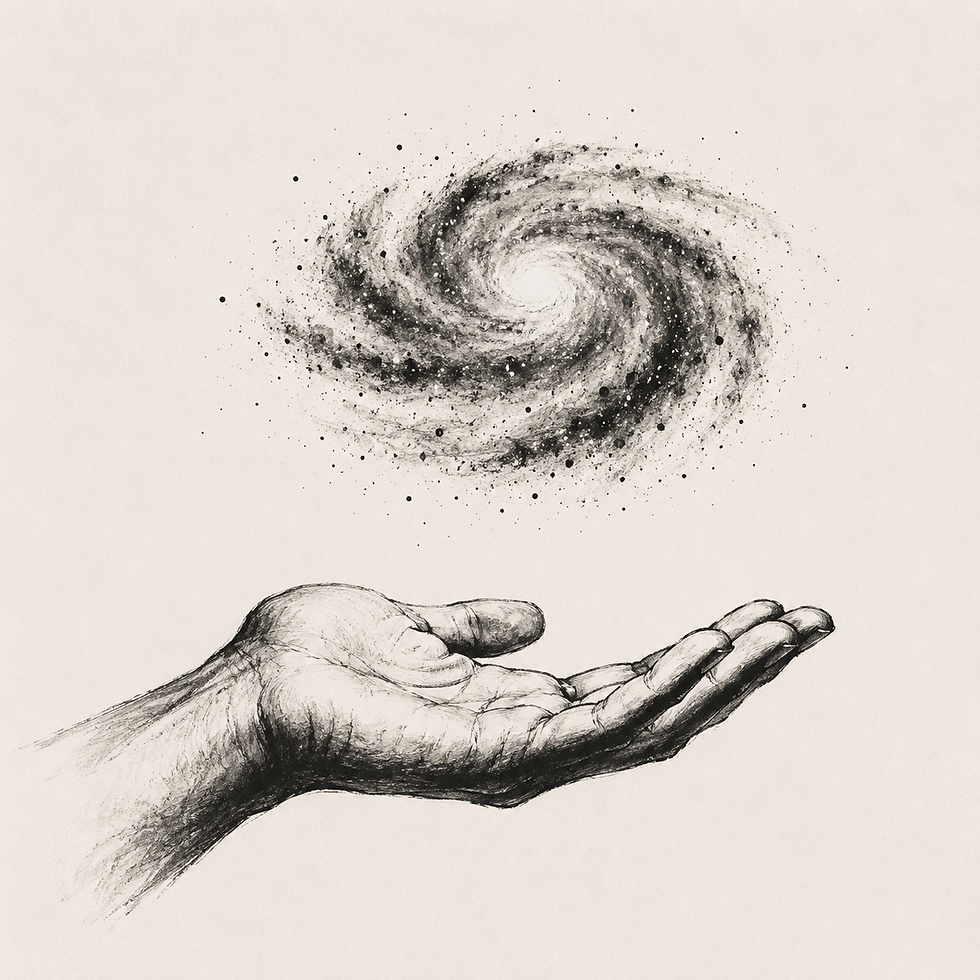
Your universe is in there. It always was.
The machine flipped the egg. It got it mostly right.
What you do next — that part, it cannot approximate.


Comments