
The Begging Bowl

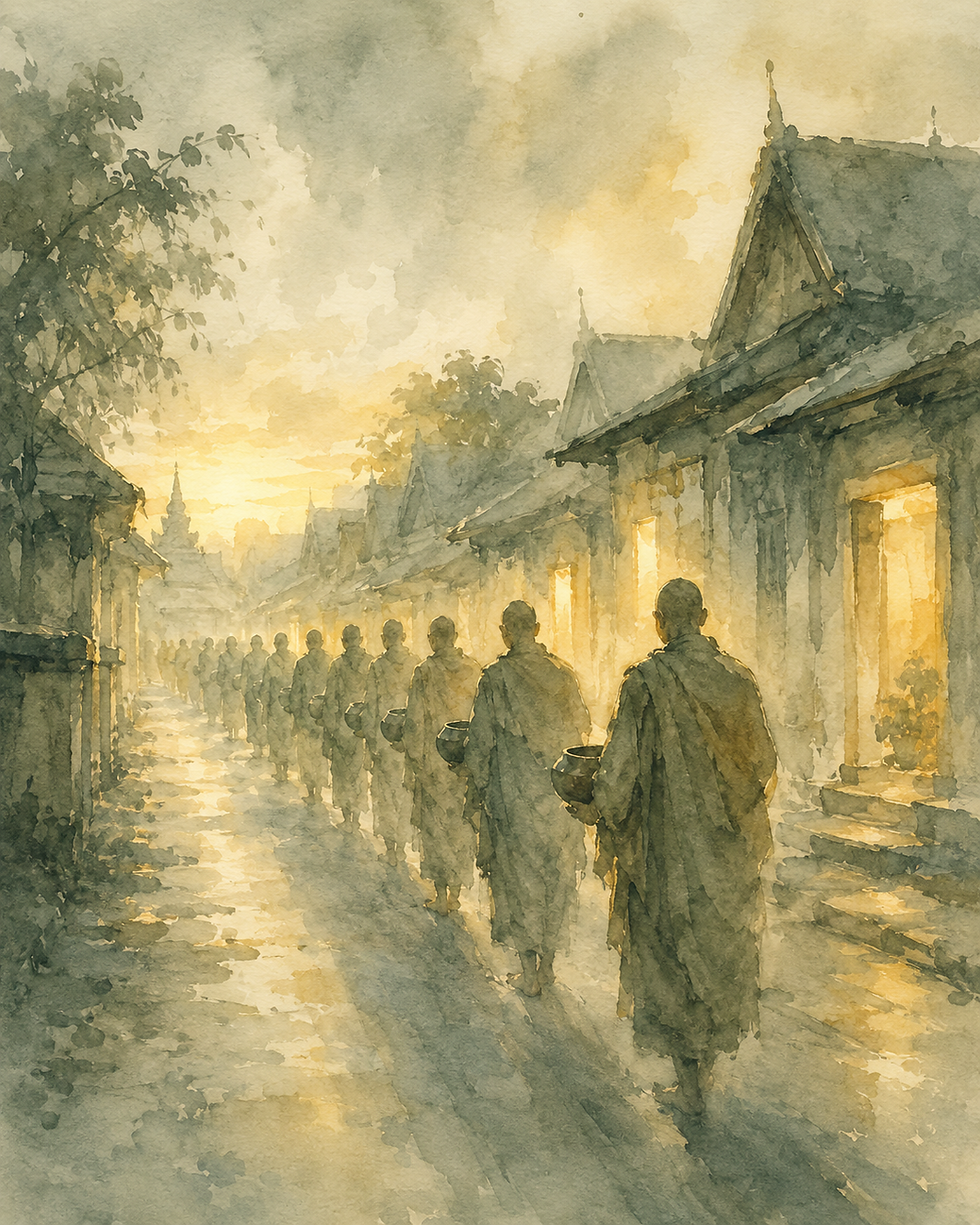
Years after he became the Buddha, Siddhartha walked back to Kapilavastu — the kingdom he had walked out of as a prince. His father, King Suddhodana, prepared a welcome worthy of a returning son. Flags, elephants, the works.
The next morning, before the palace had finished its breakfast, news reached the king. His son was in the streets. Standing at doors. Holding out a bowl.
The king found him near the market and his face had the colour of a man watching his family name dissolve in public. "Our line has produced kings for seven generations," he said. "None of them ever begged. Why do you shame us — you, who could order a hundred cooks with one word?"
The Buddha answered quietly. "Your line is a line of kings, father. Mine is now a line of the awakened. And this is our custom. The bowl is the practice."
He explained it the way you explain something to a man you love. A monk who begs his food stays at the door of strangers every single morning. He depends on whoever opens that door — a farmer, a widow, a child sent out with leftover rice. Some days the bowl fills. Some days it stays light. Either way, by noon, the man holding it has been reminded of his actual size in the universe. The teacher of kings stands in line like everyone else, and the line is the lesson.
I think about that bowl often. Because the rest of us have built lives specifically designed to avoid it.
History keeps a generous file on what happens when the bowl is missing.
In 1991, Gerald Ratner ran the largest jewellery business in the world. At a black-tie conference, riding the high of his own legend, he joked that his shops could sell a sherry decanter so cheap because it was "total crap." The room laughed. The market read the papers the next morning. Around five hundred million pounds of value evaporated, the shops closed, and his own name was removed from the company he built. Britain even minted a verb from the wreckage — to this day, a self-inflicted ego disaster is called "doing a Ratner." The man spent decades building an empire and one evening enjoying the sound of his own cleverness.
Go back further. In 1804, Aaron Burr — the sitting Vice President of the United States — heard that Alexander Hamilton had called him "despicable" at a dinner party. An adjective. Spoken over food. Burr demanded an apology, Hamilton fumbled the wording, and two of the most brilliant men of their century rowed across a river at dawn to point pistols at each other. Hamilton died. Burr lived, which was worse — his career died standing up, and he spent thirty years as a ghost at the edges of the country he helped build. One bruised ego, one adjective, two ruined men. The bullet was almost a formality.
And then there is the rare third kind of story — the ego that got hurt and paid attention. In 1985, Steve Jobs was thrown out of Apple, the company he started in his parents' garage, after a power struggle he largely manufactured himself. By every account, the young Jobs was insufferable — certain, cutting, allergic to other people being right. The firing broke something open. He later called it the best thing that ever happened to him: the weight of being successful, he said, was replaced by the lightness of being a beginner again. The man who returned to Apple twelve years later built the most valuable company on earth — and the people who knew him in both eras say the difference was simple. The second Jobs had learned to lose an argument.
Same injury, three outcomes. The ego decides which story you get.
Here is the part that fascinates me as a man who reads brain studies for fun, which my wife has learned to accept about her marriage.

Your brain treats an insult to your ego almost exactly the way it treats an injury to your body. Naomi Eisenberger's lab at UCLA put people in a scanner and had them experience social rejection — being left out of a simple ball-tossing game. The regions that lit up overlap with the ones that register physical pain. Your ego, in other words, has a nervous system. When someone laughs at your idea in a meeting, the machinery that responds is a cousin of the machinery that responds when you stub your toe. This is why a sarcastic comment from 2009 can still visit you in the shower.
Tasha Eurich, an organisational psychologist, spent years researching self-awareness and found a gap worth framing: about ninety-five percent of people believe they are self-aware. Her testing put the real figure somewhere around twelve to fifteen percent. Read that again slowly. Roughly eight out of ten people walking around certain they see themselves clearly are mistaken — and the certainty itself is the symptom. Ryan Holiday built an entire book on this, Ego Is the Enemy, and its core argument fits in one line: ego is the voice that tells you you are further along than you are.
Mike Tyson, a man professionally acquainted with reality checks, put the science more compactly than any journal: "Everyone has a plan until they get punched in the mouth." And a line long attributed to Einstein says ego and knowledge sit on opposite ends of a see-saw — as one rises, the other comes down. Whether he actually said it matters less than how true it feels at every office meeting you have ever attended.
Now place all of that inside 2026, where the ego has been given an unlimited data plan.
We carry a device whose primary economic function is measuring how much attention we receive, hourly, in public numbers. Our grandparents got a reality check at the village well. We get a dopamine report card. The car is identity. The designation is identity. The school the child attends is, somehow, also identity. I work in a bank; I watch grown men negotiate harder for a corner cabin than for an interest rate.
Against this backdrop, look at the people who kept the bowl.
Dr. APJ Abdul Kalam, as President of India, was famous for carrying his own suitcase and personally replying to schoolchildren. When he died, he owned a few clothes, a veena, and around two and a half thousand books. The country wept like it had lost a family elder — which tells you what people actually revere, underneath all the horsepower.
Rahul Dravid was offered an honorary doctorate by Bangalore University. He declined it, saying a degree should come from study, and that his wife had earned hers through years of medical college while he had merely played cricket well. The man has a stadium of achievements and behaves like a guest in his own career.
Warren Buffett, one of the richest humans in history, still lives in the Omaha house he bought in 1958 and drives himself to a breakfast that costs less than your last app-ordered coffee. Asked why, his answer amounts to: everything I want is already in there.
Watch the texture of these lives. Less defending. Less performing. Less exhausting. The ego is a full-time employee who demands a salary in attention, and these people simply kept the headcount low.
So how does an ordinary person — with a job, a boss, a housing loan, and a respectable amount of vanity — keep the ego serviced without letting it drive?
My honest suggestions, field-tested on myself with mixed results:
Keep one alms round in your week. Some task your status has excused you from. Stand in the queue. Carry the bag. Wash the plate. The Buddha begged daily; you can manage the vegetable market on Sunday.
Spend time with people who remain unimpressed by you. Children are excellent. Mothers are world-class. I have written several books, and at home this achievement carries roughly the same weight as remembering to buy curd. It is wonderfully clarifying.
Let one correction stand. Next time someone corrects you in public, try a radical experiment: say "you are right" and move on. Note how your chest tightens, how the brain drafts seventeen defences. That tightening is the ego filing a grievance. Let the file gather dust.
Ask one person, once a year, what it is like to deal with you. Then — and this is the hard part — stay silent for the entire answer.
And the line? Where humility ends and doormat begins? Here: humility is accurate self-knowledge, never self-erasure. Keep your self-respect fully funded. Stand up for your work, your people, your boundaries. The difference is simple — confidence says I can do this; ego says and therefore I am above correction. The moment feedback starts bouncing off you, confidence has quietly changed departments.
The Buddha could have eaten in a palace every day of his life. He chose the bowl, because the bowl told him the truth every morning, and palaces specialise in the other thing.
Kalam carried his suitcase. Dravid declined the doctorate. A monk stood in line outside a farmer's door. None of them shrank by it — they grew so large that ordinary people, two thousand years or two decades later, still warm their hands on the memory.
That is the strange arithmetic of humility. The ego promises that holding yourself high will make people look up to you. Life keeps demonstrating that people actually look up to the ones who bent down — to lift a suitcase, to touch their mother's feet, to receive rice from a stranger.
So find your bowl. It might be a queue, a question, a kitchen sink, an honest friend. Hold it out once in a while and let reality fill it. Some days it will come back heavy and some days light, and both days you will sleep better than the man in the palace, three towns away, rehearsing his own importance to a ceiling that has heard it all before.


https://xosoplus.mobi/ mình ghé vô thử cho biết vì thấy mọi người nói hoài, kiểu xem giao diện họ làm ra sao thôi. Vào cái là thấy họ chia mục theo ngày khá rõ, có bài XSMB theo từng ngày nên không bị lạc, nhìn tiêu đề là biết đang đọc phần nào. Mình thích nhất là cái bảng “Đầu Lô tô / Đuôi Lô tô” họ để dạng cột gọn gàng, kéo xuống là thấy ngay, không phải căng mắt tìm. Mấy khối nội dung tách ra rành mạch nên lướt trên điện thoại cũng ổn, không bị dồn chữ. Nói chung cảm giác dễ xem, đặc biệt là khu bảng Đầu Lô tô/Đuôi Lô tô hiển thị rõ ràng…
https://gg88.llc/ hôm bữa mình thấy ai đó nhắc nên mở thử cho biết, kiểu vào xem giao diện ra sao thôi. Cảm giác đầu tiên là trang nhìn khá sạch sẽ, tối giản chứ không bị rối mắt, màu mè quá đà. Mình chỉ lướt nhanh chứ không đọc kỹ, nhưng cách họ chia nội dung theo từng khối nhìn dễ nắm, mới vào cũng biết mình đang ở phần giới thiệu chung hay phần trải nghiệm. Cuộn xuống thấy mượt, bấm qua lại mấy mục cũng không bị loạn hay phải tìm hoài. Nói chung ai thích kiểu “vào là thấy rõ” chắc sẽ hợp, vì bố cục sắp xếp khá khoa học và các danh mục hiện ra…
This was a nice read because it stayed simple and didn’t feel like it was trying to impress me with jargon. I liked how it explained the reasoning behind the tips instead of just tossing out a checklist, and the quick examples made it easier to picture in real life. Halfway through I ended up clicking around newimage.io since it gives off a similar “helpful but not preachy” vibe when you want to explore a bit more. Everything felt written by someone who’s actually tried this stuff, not just recycling the same generic lines. Also, the page itself was easy on the eyes—short chunks of text, clear headings, and it’s super skimmable because the sections are spaced out cleanly.